Why Nvidia's Technology Became Critical to Modern AI
Nvidia became critical to modern AI by combining GPUs, CUDA, high-speed networking and a software ecosystem built to scale machine learning.
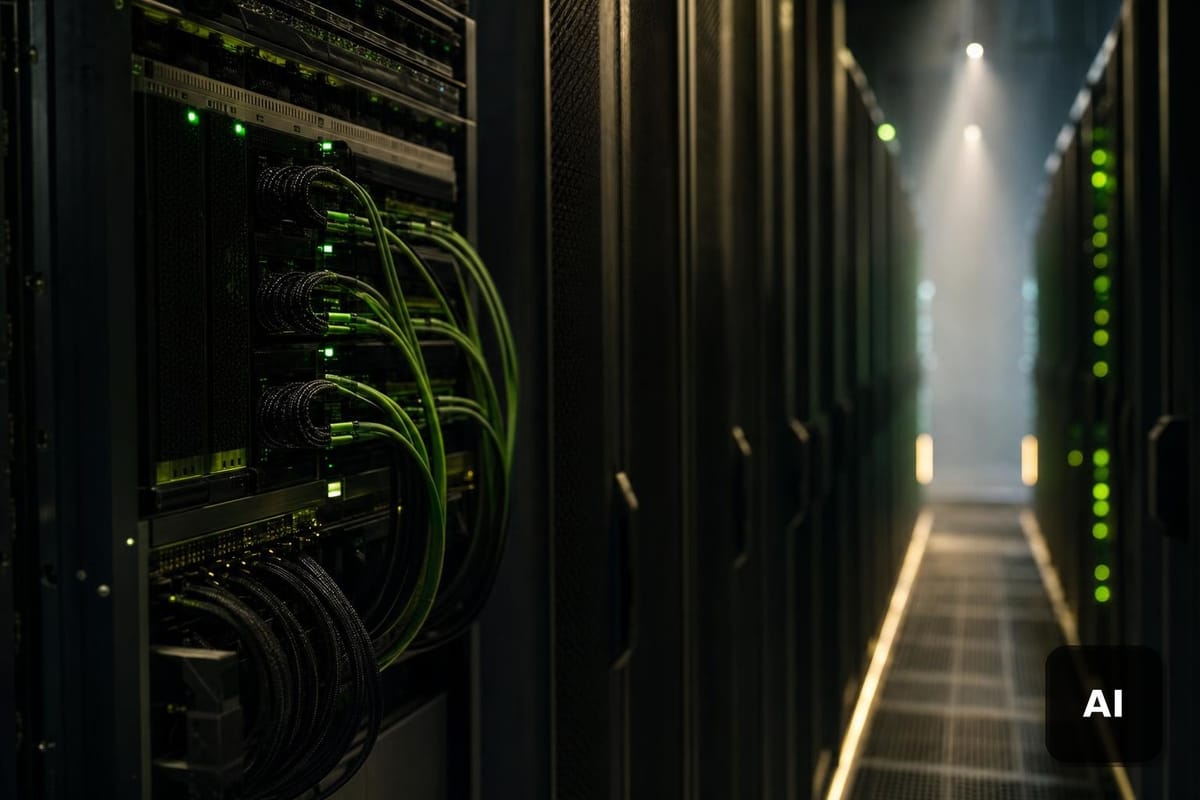
Nvidia’s importance to modern AI is easiest to misunderstand at the chip level. The strategic asset is not a GPU specification but an integrated accelerated-computing platform spanning processors, CUDA, tuned libraries, framework support, memory, interconnects, networking and deployment software. Each layer makes the next one more useful—and makes the combined system harder to replace than any individual component.
This is heterogeneous computing, not a CPU-versus-GPU contest. CPUs still orchestrate programs, prepare data, manage storage and networking, and handle irregular control flow. GPUs take over operations large and regular enough—especially tensor operations—to keep thousands of execution units busy.
The first bridge was programmability. Nvidia introduced CUDA’s general-purpose programming model in 2006, giving developers a practical way to target parallel hardware without expressing computation through graphics APIs. CUDA did not create deep learning, but it made the GPU available to researchers who needed more arithmetic throughput than conventional CPU execution could economically provide. (docs.nvidia.com)
The second bridge was proof. The 2012 AlexNet paper used an efficient GPU implementation to train a large convolutional network and materially improve ImageNet results. The important shift was practical: GPUs could change which neural networks were feasible to train, not merely run an existing workload somewhat faster. (papers.nips.cc)
CUDA alone would not have sustained that adoption. Nvidia accumulated cuBLAS for linear algebra, cuDNN for neural-network primitives and architecture-specific kernels that hid much of the hardware tuning from application developers. Framework integrations then placed those components directly in the path of ordinary model code.
Consider a matrix multiplication between two PyTorch tensors stored on a CUDA device. PyTorch dispatches the operation to its CUDA backend, which can invoke cuBLAS or another tuned implementation selected for the tensor shape, datatype and GPU architecture. A convolution may similarly reach cuDNN, while compilation can fuse surrounding operators into fewer launches. The developer writes a tensor expression; the platform supplies the increasingly specialized execution path.
That path fits neural networks because dense matrix multiplication and convolution offer large amounts of parallel work with predictable data access. Transformer training contains many similar operations, but attention is not only matrix multiplication: it also requires reductions, softmax, masking and repeated movement through the memory hierarchy. Keeping arithmetic units busy depends on arranging all of those steps, not just accelerating the largest multiply.
Volta’s 2017 Tensor Cores marked a hardware shift from general parallel arithmetic toward dedicated matrix-multiply-accumulate units. Software support made the units usable through libraries and frameworks rather than requiring every model team to program them directly. FP16 and BF16 are established training formats; FP8 requires appropriate architecture, scaling and accumulation support, while FP4 is primarily useful for quantized inference on newer systems. Each reduction in precision can improve throughput and memory efficiency, but also narrows representation and introduces calibration or accuracy risks.
Memory placement is often as important as arithmetic. Registers and on-chip shared memory feed active compute units, while HBM holds model weights, activations and inference KV caches. Performance deteriorates when kernels spend more time transferring tensors to and from HBM than operating on them.
FlashAttention made that constraint unusually visible. Its key improvement was an attention algorithm organized to reduce expensive HBM reads and writes by working in tiles closer to the compute units. The result illustrated a broader rule: reducing data movement can matter more than reducing the nominal operation count.
Different AI workloads expose different bottlenecks. Training performs forward and backward tensor operations, retains or recomputes activations, updates parameters and synchronizes gradients across devices. It tends to reward compute throughput, HBM capacity and efficient collective communication at the same time.
Inference splits again. Prefill can process many tokens from a prompt in parallel, producing substantial matrix work. Autoregressive decoding must wait for one generated token before computing the next, so it is often limited by model-weight and KV-cache movement, available memory capacity, bandwidth and the batch size a serving system can assemble without violating latency targets.
Once a model no longer fits efficiently on one GPU, communication becomes part of execution. NVLink supplies direct high-bandwidth scale-up connections between GPUs, while NVSwitch creates a larger in-rack fabric. NCCL maps collectives such as all-reduce and all-gather onto that topology; InfiniBand or Ethernet carries scale-out traffic between racks. Training may use collectives to synchronize gradients, while tensor-parallel inference exchanges intermediate results within each generated-token step.
NVL72-class systems are the current endpoint of Nvidia’s move from accelerator cards toward engineered compute domains. The rack-scale networking design combines CPUs, GPUs, NVLink switches, network adapters and separate fabrics for compute, storage and management. Power delivery, liquid cooling and system software become architectural components because a rack cannot behave like one machine if its thermal, network or operational layers are assembled independently. (docs.nvidia.com)
The less visible advantage is adoption friction. Prebuilt framework packages and containers provide tested combinations; libraries carry kernels tuned for successive GPU architectures; CUDA compatibility reduces forced rewrites; Nsight exposes kernel and communication bottlenecks; graph capture and compilation cut launch overhead; NCCL handles topology-aware communication; and TensorRT or TensorRT-LLM optimizes deployment through precision selection, fusion, scheduling and KV-cache management.
These mechanisms form a reinforcing loop. A large CUDA software base attracts framework maintainers and kernel engineers; their optimizations make production behavior more predictable; that reliability makes Nvidia the lowest-friction target for more teams. Hardware demand then justifies further optimization across libraries, compilers, communications and deployment runtimes.
The platform still has hard limits. Rack power density and cooling requirements restrict where systems can be installed; HBM capacity constrains model size and inference context; collectives can erase compute gains at scale; supply concentration creates operational risk; and deeply CUDA-specific kernels increase migration costs. AMD’s ROCm challenges the framework-and-library layer, while Google TPUs and AWS Trainium pair specialized accelerators with vertically integrated cloud software and networking.
OpenXLA-style interfaces can make frameworks less dependent on one device API, but code portability does not guarantee performance portability. Memory layouts, fused kernels, compiler decisions and collective strategies still need target-specific work. Nvidia’s position will therefore be tested layer by layer—not by a rival posting a higher peak number, but by alternatives making the entire path from model code to distributed deployment comparably dependable.